Japanese Cultural Workshop: "Dressing and Experiencing the Jūnihitoe - Traditional Japanese Attire" Held
On December 10, 2025, the Center for Japanese Language and Culture hosted a Japanese cultural workshop titled "Dressing and Experiencing the Jūnihitoe1 - Traditional Japanese Attire."
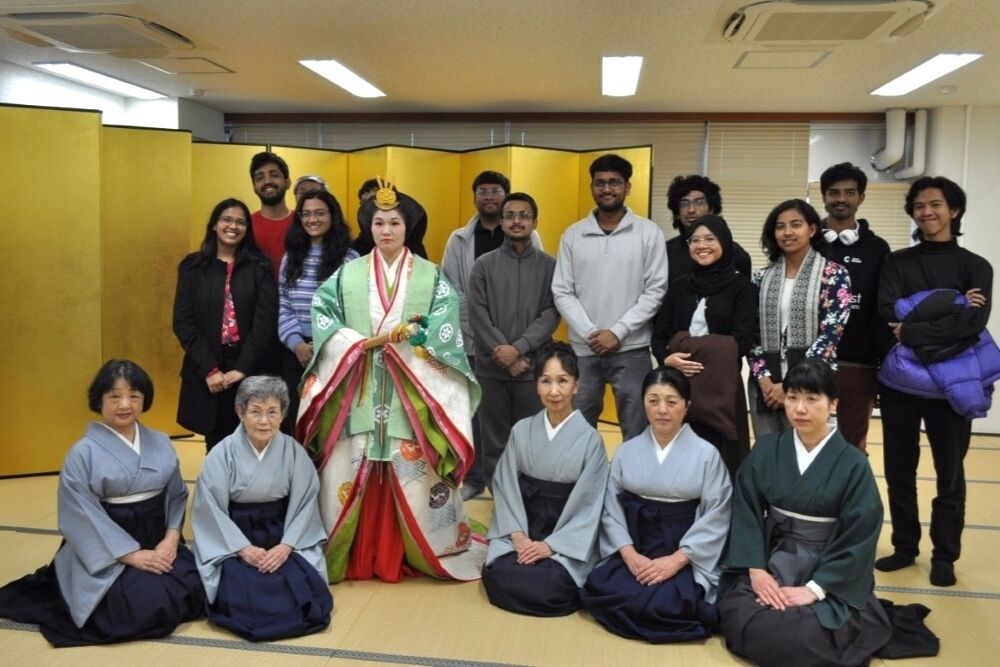
The event welcomed approximately 50 participants, including students from the Indian Institute of Technology Guwahati in India and the National University of Malaysia in Malaysia, who were attending an annual short-term inbound program, "Winter School 2025," international students enrolled in the Japanese Language and Culture Studies Course, and the Japanese Society and Culture Program at the Center, as well as other international and Japanese students and faculty members of Gifu University.
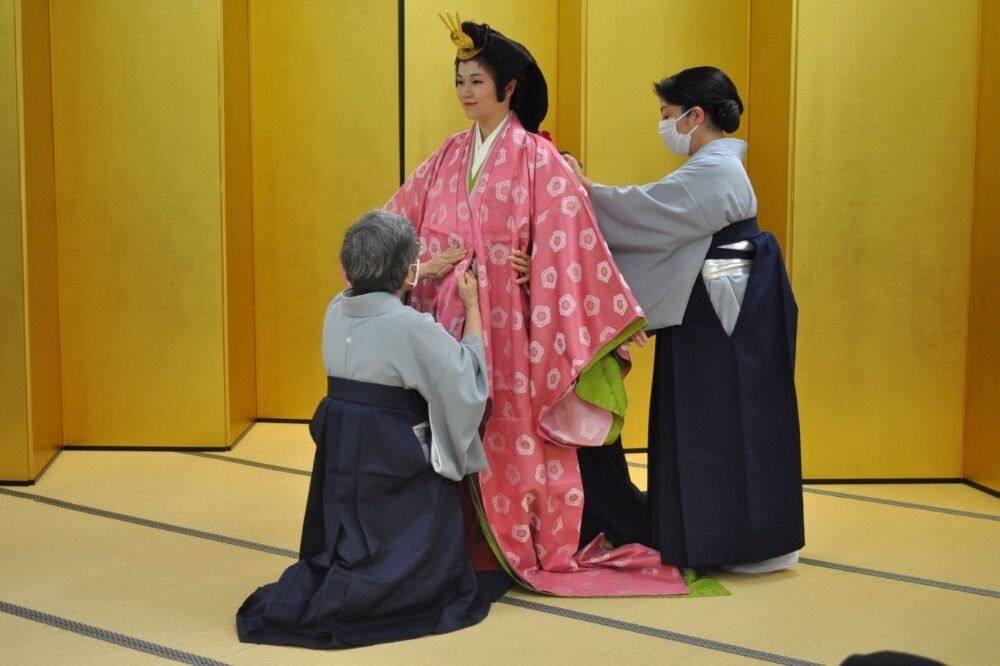
The workshop featured instruction by Ms. ITO Keiko (professional alias: Houshoukei), a specialist in traditional Japanese kimono dressing, along with four other instructors. A live performance of the koto harp added to the solemn and elegant atmosphere, allowing participants to appreciate the beauty of the Jūnihitoe.
Professor TSUCHIYA Momoko of the Center provided explanations in both Japanese and English about Japanese history and the basics of the Jūnihitoe. Following this, Ms. ZHU JIAOMEI, an international student from China served as the dressing model. After preparing the kosode2 and nagabakama3, the layers were dressed in order: hitoe, itsutsuginu, uwagi, karaginu, and mo. Participants asked questions such as "Was the Jūnihitoe worn every day?" and "How did they manage to use the restroom?" to which the instructors responded carefully.
After the demonstration, volunteers had the opportunity to try on the Jūnihitoe themselves. Many students experienced its weight firsthand and enjoyed taking commemorative photos. Participants shared impressions such as, "I was able to fully appreciate the depth and beauty of traditional Japanese culture," making this a meaningful opportunity that contributed to the enrichment of Japanese cultural education.
The Center for Japanese Language and Culture will continue to provide hands-on experiences that allow participants to actively engage with and understand Japanese culture.
1) a traditional Japanese court attire worn by noble women during the Heian period (794 to 1185). It consists of multiple layers of silk robes, typically twelve, and is known for its elegance and intricate color combinations.
2) a traditional Japanese garment with small sleeve openings
3) a type of traditional Japanese trousers with long, trailing legs that cover the feet and extend into a train at the back